

Global Plastic and Waste Data Tracker
New and improved. Monitoring government plastics data across the full supply chain - explore the global data and interactive maps
Learn More
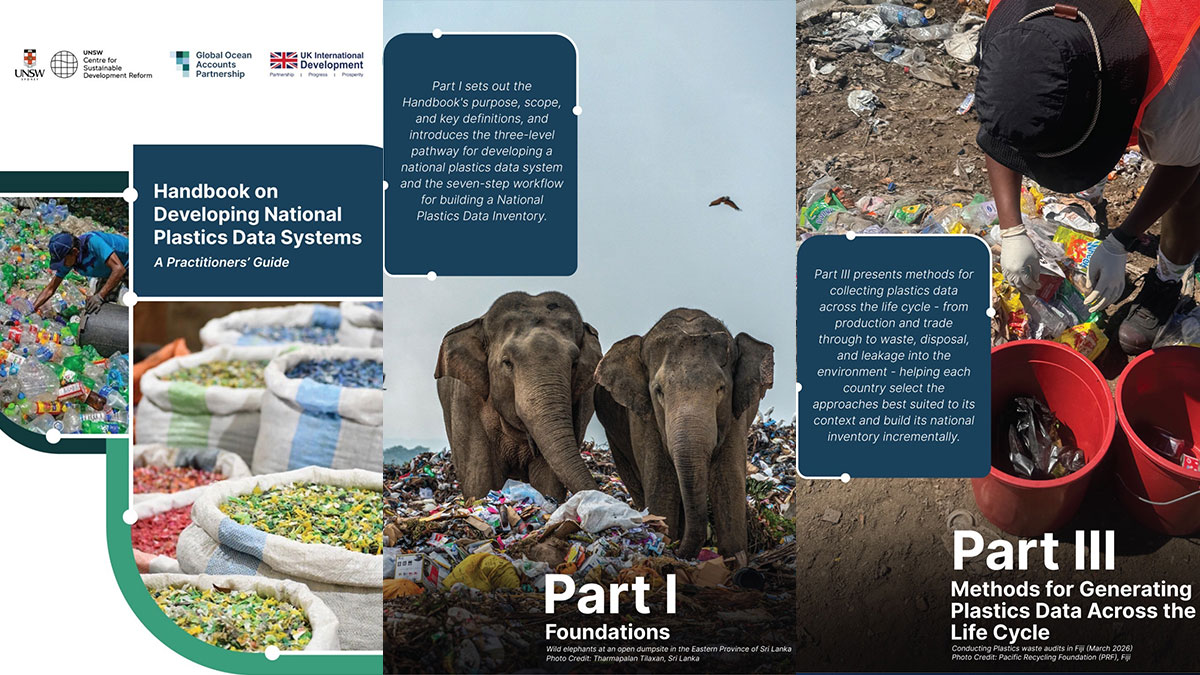
A practical guide to help governments build national data systems that track plastics throughout the lifecycle and inform evidence-based policy.
The Handbook for Developing National Plastics Data Systems gives government officials and practitioners a structured, practical approach to building national plastics data systems. It is designed to support countries to build the data foundations needed to design policies and management plans that effectively manage plastics.
Developed jointly by the Global Ocean Accounts Partnership (GOAP), the UNSW Centre for Sustainable Development Reform (CSDR) and GRID-Arendal, it sets out seven steps, from identifying relevant data through to establishing systems for ongoing data management.
Watch the global launch event
The Handbook was officially launched 9 September 2026
The session walked through the Handbook’s framework and tools and demonstrated the redesigned Tracker. You can hear country perspectives from Fiji and Sri Lanka on the practical challenges and value of building better plastics data systems. Watch the video recording.
Plastic moves through economies and environments in ways that are difficult to see and harder to regulate. Without data across the lifecycle of plastics, from production to pollution, governments and decision-makers are ‘flying blind’. Data on plastics is necessary to design targeted regulations, allocate resources, evaluate whether interventions work, or track progress against national and international commitments.
Effectively managing plastics depends on systematic data collection. Without it, governments are designing policy without evidence of how plastics is flowing through their economies and environments.
Many countries currently lack a coordinated data collection framework, standardised methodologies, clear institutional arrangements, or the technical capacity to manage plastics data over time. The Handbook was created to close that gap.
The Handbook provides seven key steps to developing national data systems for plastics:
Recognising that comprehensive data development requires time and capacity building, the Handbook supports users’ journeys regardless of their starting point or immediate capacity, supporting from improving a single data category, all the way to developing Plastics Accounts. The Handbook is based on GOAP’s experience supporting countries to develop national data systems for marine and coastal environments (Ocean Accounts) since 2019.
While primarily designed for policymakers and government officials responsible for environmental management, waste systems, and statistical development, the Handbook is accessible and relevant to a broad range of stakeholders who will find practical methodologies applicable to their work.
Download the Plastics Data HandbookPreparation of this publication was funded by the United Kingdom Government’s Blue Planet Fund.
Alongside the Handbook, GOAP has developed the Global Plastics Data Tracker: a publicly available platform that maps the availability and reliability of reporting of global plastics data for 193 countries globally.
The Data Tracker was launched in November 2025 ahead of negotiations for the global plastics treaty and updated in June 2026.
Use the Global Plastics Data Tracker now
New and improved. Monitoring government plastics data across the full supply chain - explore the global data and interactive maps
Learn More

In the context of the global plastic treaty, this Checklist outlines data required to understand the flows of plastics through a national economy and into the environment
Learn More
Learn More